Contactless update

[Dave Birch] OK, I’ve been thinking about contactless again, following some more discussions that I got caught up in today after I mentioned that yet another person in a shop in London had asked me where I got my iPhone sticker from. This led me to think back a couple of week, because I’d thoroughly enjoyed SMi’s Contactless Cards and Payments 2010 held in London. They had a really good range of speakers (including me) looking at different aspects of the European contactless landscape, and a number of different European perspectives.

First of all, let’s just reinforce the link between contactless and cash replacement. MasterCard’s figures show that only 4% of PayPass “taps” in Europe are for transactions above $50 and the average transaction value varies by country from around $5 to around $14. At the conference, they also gave a good case study on Carrefour and I recently saw an updated version of this case study from someone else. Carrefour have just issued three million contactless credit cards in eight months and upgraded 22,000 terminals take contactless payments. At the time of writing, they are seeing that over a third of their under €20 euro transactions are already contactless (displacing mainly cash) and that they have migrated 6% of transactions from debit to credit (which is, presumably, more profitable for them since it’s their own credit cards). Having said all that, and noted the Visa figures for the UK,

Several payments executives say consumer interest in the technology is falling off, and they blame the banks’ and card networks’ apathy.

[From Has 'Tap and Go' Lost Its Touch? - Bank Technology News Article]

I’m not sure I would agree: the “blame” must be more widespread because it seems to me that contactless as POS as it stands is not that exciting. In many of the places where cash replacement would be very attractive (eg, vending machines) there are no contactless terminals and in many of the places where there are contactless terminals (eg, my dry cleaners) they will never be used. In other words, there could be a much better alignment between the terminal deployment strategy and the cash replacement strategy. Other people, though, are suggesting other remedies.

Banks making a concerted push to promote contactless payment technology are focusing on the wrong target and should switch their short-term focus to mobile commerce.

[From Analyst Labels M-Commerce Renaissance a Priority by Bank Systems & Technology]

I draw a slightly different conclusion: banks should invest in contactless payments and in mobile payments on the same roadmap, so that in the time the investments are not wasted. What this means in practice is that the banks (and the retailers) should be planning for a new generation of value-added services that will be enabled by the combination of the mobile phone and the contactless interface.

[Read more...]

These are the personal opinions of Consult Hyperion and its guests and should not be misunderstood as representing the opinion of its clients or suppliers. To discuss how any of the technologies discussed in this post can benefit your business, please contact Consult Hyperion.
Law 2.5 or 3.0 or whatever

[Dave Birch] Now, as I’m fond of saying, the whole real/virtual thing is a bit fuzzy. One of the areas where this is frequently demonstrated is crime…

the Habbo Hotel folks have now asked Finnish police to investigate 400 cases of “theft” in their world. Seriously. Of course it is a bit more complicated than that. They’re really upset about phishing scams that let scammers get users login information, which they then use to get into their account and transfer the virtual goods away. But that’s not really “theft” and it’s a misnomer to call it that.

[From Yet Again, Real Police Called Into Virtual World Over (Not Really) Theft Of Virtual Items | Techdirt]

Correct. This isn’t theft any more than copying an MP3 is theft, but it is closer to what we might think of as theft in that it’s fraud, but it’s fraud that prevents the rightful owner of the virtual goods from enjoying their use (which is not the case when a teenager copies a friends CD).

And, really, if Habbo Hotel users are getting phished so frequently, perhaps the Habbo developers should focus on building a better login system that is not so susceptible to simple phishing scams..

[From Yet Again, Real Police Called Into Virtual World Over (Not Really) Theft Of Virtual Items | Techdirt]

This is correct. It it wrong to expect the rest of society to pay to support a business model that is founded on technology that is not fit for purpose. You wouldn’t let carmakers sell vehicles without locks to save money while simultaneously lobbying for higher spending on the police to prevent car theft.

But here’s an interesting thought experiment. If there were a working digital identity infrastructure, would it be possible to build a working law enforcement system on top of it? I think the answer is yes, because crime and punishment would both be founded on the management of reputation. Think of the example of eBay stars: if I am a top seller on eBay, then taking away my stars is a serious punishment, much worse than fining me money or, in some cases, locking me up.

[Read more...]

These are the personal opinions of Consult Hyperion and its guests and should not be misunderstood as representing the opinion of its clients or suppliers. To discuss how any of the technologies discussed in this post can benefit your business, please contact Consult Hyperion.

Crunching

[Dave Birch] I went along to the Financial Services Research Forum summer seminar in London, which was about “Responsible Lending and Borrowing”. I thought I might pick up a few ideas for new products for our financial services customers and I was curious to understand how some of the effects of the post-credit crunch economy might bound new service development. And I was curious to see some of the speakers, who were clearly going to approach the issue from perspectives that were unfamiliar (to me).

The big picture was presented by the Future Foundation who said, essentially, that consumers remain cautious and have been paying down debt, particularly on mortgages, personals loans and credit cards. What I also noted was that they were very positive about the opportunities that might arise because of new entrants into the financial services sectors, one of the themese that emerged from the roundtable series that I ran as part of the CSFI Fellowship programme. Now, on the one hand this is not particularly radical thinking…

I also got some good input from one banking expert this week, who reckons that Virgin will be a ‘mortgage bank’ like the Abbey and Halifax were a decade ago; and Tesco will be a massive data mining financial warehouse of risk analytics for cross-selling insurances and loans to their Clubcard holders.

[From The Financial Services Club's Blog: More on Tesco, Virgin and Metro Banks]

…but on the other hand, I wonder if we (ie, people in the industry) are thinking far enough outside the box, because the nature of new entrants is likely to mean real changes in the nature of some products. I tend to focus on the payment-related products and value-added services, of course, but the dynamics presumably extend beyond that.

Angela Sasse and Hazel Lacohee from PVNets gave interesting presentations on different aspect of privacy in financial services. I did disagree with Hazel slightly, because I’m not sure that some form of “basic bank account” is the first step on the road to financial inclusion, I still think that we should be shifting the focus to separate transaction banking further from relationship banking and then replacing transaction banking with transaction accounts (ie, prepaid accounts with card and mobile front-ends) as the first rung on the inclusion ladder (as I heard someone else call it).

All in all, an interesting event. I’m not sure we’re any nearer creating or maintaing a culture of responsible lending, but I am more optimistic than I was at the start. And the talk by Paul Lewis of Moneybox Live was outstanding, especially his points about the way bank charges are represented and understood.

On that topic, the OFT gave a review of the changes in consumer credit legislation in recent times, which seemed mainly to do with the credit providers giving detailed information to borrowers, but it’s not obvious to me that this will make much difference in a country where a high proportion of people are financially illiterate and a substantial proportion of people are functionally illiterate. I happened to be reading about this in another context:

Research shows that 53% of adults in Wales have numeracy skills below the level expected of an 11-year-old.

[From BBC News - 'Lessons to learn' in numeracy teaching says Estyn]

I don’t think that giving these people more leaflets will help. People don’t understand what an APR is, so printing it in bigger letters isn’t going to help. As I’ve heard people say before, since 50% of people don’t know what 50% means, it’s a long haul. And it’s not easy: people who don’t understand APRs are not all thick, as one of Paul’s examples that i mentioned on Twitter shows, and it’s worth repeating here. Imagine you are down the pub and you’ve run out of money, so you say to a friend “lend me twenty quid and I’ll give it back to you in a week when I get paid, and I’ll buy you a pint for the favour”. If a pint of beer costs £1.40 (let’s pretend we’re up North, or in 1990) then what is the APR on your payday loan? I leave it as an exercise to the reader, and there is no prize. However…

[Read more...]

These are the personal opinions of Consult Hyperion and its guests and should not be misunderstood as representing the opinion of its clients or suppliers. To discuss how any of the technologies discussed in this post can benefit your business, please contact Consult Hyperion.

There isn’t an app for that

[Dave Birch] Hurrah! My bank, Barclays, tell me that they have a new and improved mobile bank service. Fantastic. I go to the iTunes App Store. Nothing there. Odd. Turns out that the new and improved mobile bank service is just the web service but on a mobile phone. Oh well.

With odd serendipity, this came up at the recent Mobey Forum meeting in Helsinki. While watching a demonstration of Nokia Money, I got a text message from my son who was in London visiting his girlfriend and had run out of money. He asked me if I could send him £10 to get a train home. I was forced to reply that I could not, because we live in the UK and not in an advanced country such as Kenya, where phone-to-phone money transfer is commonplace. I fired up my iPhone and went to the Barclays page, only to discover that I couldn’t log in and send him some money because I don’t know my 12 digit user code (or whatever it is called) and I didn’t have my dongle anyway (it was back home on my desk). (In case you are worried, the day was saved because he was able to go back to his girlfriend’s house and borrow the money from her parents.)

Now, this demonstration of the utter hopelessness of mobile financial services in the UK took place under the watchful eye for Mobey Forum executive director Liisa Kannainen, who promptly showed me how she had responded to an earlier, similar, request from one of her children…

Liisa

Yes, she still uses the same paper-based Nordea Transaction Authorisation Number (TAN) system introduced in Finland for remote banking years ago, And it still works fine. So to send her kids money, she logs in on the phone and is prompted for the next TAN. She types it in and then crosses it off. Works perfectly. And she always has her TAN list with her in her purse, whereas as I never have my dongle with me away from home.

What I do have with me all the time is, of course, my mobile phone. As do almost all of the population. Surely it would make sense for both Nordea and Barclays to move to some standard mobile phone-based 2FA scheme. And then we could move to a standard set of authentication “levels”. For small transactions, just have the phone. For larger transactions, enter PIN into the phone. For very large transactions have the take your voiceprint, then enter a PIN. Something like that. And if we could use it log in for banking, then why couldn’t we use it to log in for other things as well

[Read more...]

These are the personal opinions of Consult Hyperion and its guests and should not be misunderstood as representing the opinion of its clients or suppliers. To discuss how any of the technologies discussed in this post can benefit your business, please contact Consult Hyperion.

War on cash: a report from the European front

[Dave Birch] I have said, a few times, in a variety of forums, that I think that the e-payment industry should be more aggressive. Instead of listening to regulators complain about the cost of e-payments, we should complain to the regulators about the cost of cash and ask for a level playing field. The good people at European Financial Management and Marketing Association (EFMA) have invited me to speak at their October conference on Cash Processing in Paris. They say that

In 2009, euro banknotes in circulation grew by 6% to reach € 806 billion in December; this followed the exceptional growth of 13 % experienced in 2008 in the wake of the financial crisis. In these times of high financial uncertainty, cash remains an element of stability and contributes to consumer confidence in the financial system. This continued growth in cash emphasizes the importance for banks to pursue their efforts to further optimize the cash cycle

[From EFMA - Upcoming event]

Well, if the amount of cash in circulation is going up at a time when the economy is contracting and government tax revenues are falling, I think I draw a slightly different conclusion, and this is what I’ll be talking about in October.

[Read more...]

These are the personal opinions of Consult Hyperion and its guests and should not be misunderstood as representing the opinion of its clients or suppliers. To discuss how any of the technologies discussed in this post can benefit your business, please contact Consult Hyperion.

A steak in the ground

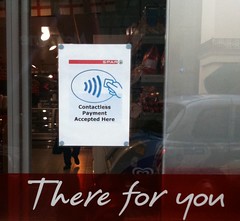
[Dave Birch] The news that Boots is going to trial contactless payments suggests that things are about to improve in that world. It’s clearly important for the contactless payments sector that high street brands such as Boots are on board, although I’m not quite how it will work. I’d imagined that Boots will set aside one or two terminals for sandwiches and drinks and add contactless there, because I wasn’t sure what would be gained by adding it to all of the POS locations. But I went in to Boots today and, oddly, contactless had been added to all of the normal POS terminals but not to the self-service quick-checkout areas for buying sandwiches and drinks. Nonetheless, a couple of us bought stuff and the terminals worked fine.

IMG_0012

I asked the guying serving me what he though about contactless and he told me that customers were using the contactless terminals and that the customers who used the contactless terminals really liked it. So my random sample of one POS at one store tells me that contactless is gaining ground. Not everyone thinks this.

Much hyped contactless payments may be a long way off from becoming the norm in the UK – despite trials by retailer Boots ahead of a potential roll out at their till-points nationwide – because the recession has delayed both retailers and issuers from investing the technology, finds analyst Datamonitor.

[From Internet Retailing » Contactless payments not taking off as recession curbs retailer and bank investment in the technology]

Hhhmmm. Meanwhile,

According to Euromonitor findings, the spread of contactless card technology has continued apace on a global level through 2010, gathering momentum in markets outside first mover region Asia Pacific. Despite decreased consumer spending and tighter margins for both card issuers and retailers during the global recession, investment in contactless technology is growing as both industry and consumers realize the benefits of contactless products.

[From Euromonitor research finds contactless card growth solid despite global recession - Market Research, Analysis, and Trends Blog]

I’ve no way of judging which of these is the more accurate reflection of the state of play, since I don’t have access to any accurate public figures on the rate of deployment of contactless terminals in the UK or transaction figures, but I must point out that I have started to see more terminals popping up in various places in London.

IMG_0105

What remains puzzling to me, though, speaking only as an observer, is why contactless remains absent in locations where cash is a nuisance, such as the vending machines on the London Underground. I mentioned before (in the Parable of Woking) that the car park that I use most is probably lost to cards — contactless or otherwise — forever now, since the card slots have been disabled…

P1000461

The future’s so bright I gotta wear shades. People seem to happily pay the 40p convenience charge for not using cash here, so presumably there is a convenience premium for contactless that can help to spread to the technology. But wait: a correspondent writes…

“Yesterday I went to buy my weekly steak and when paying for purchases less than GBP 10, my butcher says he needs to charge an extra 50p. I really don’t get this. Why is there a minimum payment? And does this not fly in the face of low value contactless payments the you guys are pushing. WTF?”

My response to this would have been to put the steak down and go and buy it somewhere else, but I can see my correspondent’s point. Where does the surcharge come from? The interchange on contactless transactions (currently under GBP 15) is probably around 4p, so if the butcher installed such a terminal he would not only speed up the POS but be able to offer a reasonable deal to his customers, who want to pay with debit cards. One approach might be the “broadband” angle being considered by the Dutch (I’ll blog about this shortly), whereby these kinds of smaller retailers pay a monthly flat fee to cover the terminal rental and broadband connection, and this fee includes the MSC for all contactless debit transactions, thus (hopefully) aligning the private and social costs more efficiently (it’s better for society as a whole if people use debit cards rather than cash).

But how come the car park can charge 40p for not using cash and it doesn’t bother me, whereas it would really annoy me if the butcher charged me 40p for buying some sausages without cash? It must be something to do with the user experience. At the station I’m not just paying extra to not use cash, I’m paying extra to sort out my parking while I’m walking to, or sitting on, the train. It’s not the payment transaction that is enhanced by going cashless but the value-added around the payment transaction.

[Read more...]

These are the personal opinions of Consult Hyperion and its guests and should not be misunderstood as representing the opinion of its clients or suppliers. To discuss how any of the technologies discussed in this post can benefit your business, please contact Consult Hyperion.